
How do you collect credit sales (veresiye)?
A credit receivable (veresiye) is collected by agreeing on a payment date the day the credit is given and recording it, sending a short reminder one day before the due date, getting in touch within the first three days if it becomes late, and accepting partial payments and entering every collection in the ledger the same day. What speeds up collection is not pressure but timely, recorded follow-up: a debt with an agreed and written date can be reminded; a debt with no agreed date gets forgotten.
Last updated: September 17, 2026
Collection starts the day you open the ledger
A shopkeeper's collection problem usually doesn't arise at the collection stage but at the moment the credit is given. The amount is written down, the date is not discussed; a few weeks later all that's left is a figure and the conversation starts with "when did we say?" The seven steps below reverse that order: first the date, then the record, then the reminder.
We explained which fields to write in the ledger and how to set a limit in how to keep a credit ledger (veresiye defteri); this page covers the getting the money back flow for the shopkeeper who has already made the entry.
Collection in seven steps
- Agree on the due date when you give the credit
Collection starts the day the debt arises. When you write the amount, also ask "when?" and put the answer in the ledger. A debt with no agreed date turns into "I forgot" two weeks later; a debt with an agreed date is one you can remind about.
- Write the entry the same day and in full
The date, customer, amount, what was bought and the promised payment date must be written all at once. An entry left until evening gets written incompletely, and an incomplete entry turns into an argument at collection time.
- Send a short reminder one day before the due date
A reminder sent before the due date is not pressure, it is information: "it's due tomorrow." It gives the customer a day to set the money aside and keeps some of the late payments from ever starting.
- Get in touch in the first three days of lateness
If the due date has passed, call within the first three days, not a week later. As time passes two things grow at once: the amount and the difficulty of the conversation. A short call made early is easier than a long argument a month later.
- Accept partial payments and enter them the same day
Saying "bring it all at once" often ends with nothing being brought at all. Don't refuse the amount that arrives; enter it in the ledger the same day and show the customer the remaining balance — a customer who sees the debt shrinking keeps paying.
- If the debt is dragging on, stop new credit
Writing new credit while there is an unpaid balance only enlarges the amount you can't collect. Discuss a payment plan with the customer: how much in which week. A plan always works better than "as soon as possible."
- If the amount is large, move to a written document
The ledger you keep yourself is your own record; when the amount grows, the customer's written acknowledgment (a signed debt acknowledgment or a promissory note, "senet") strengthens your hand. Anything beyond this stage is a legal process; consult a lawyer depending on the amount and circumstances.
What to do depending on how late it is
The same debt calls for different behavior depending on which day of lateness you are on. The sequence below is meant to run collection without turning it into personal tension.
| When | What to do | Tone |
|---|---|---|
| 1 day before the due date | Short written reminder | Informative |
| Due date | Wait; check the records in the evening | No contact |
| 1–3 days late | Phone: today or the weekend? | Ask for a specific day |
| 1–2 weeks | Meet in person, offer a partial payment | Solution-oriented |
| 1 month | Stop new credit, write a payment plan | Clear but respectful |
| 2 months or more | Print an account statement, ask for a written acknowledgment of the debt | Based on the records |
What should a reminder message say?
A good reminder carries three things: the amount, the date and an easy option. Blame, reproach and "enough is enough" sentences don't speed up collection; they put the other side on the defensive. Three examples:
| Status | Sample message |
|---|---|
| One day before the due date | “Hello Mr. Ahmet, your payment of ₺1.250 is due tomorrow. If it suits you, I'll expect you at the shop. Have a good day.” |
| First days of lateness | “Hello, your current balance shows as ₺1.250. Could you stop by today, or should we wait for Saturday?” |
| Partial payment offer | “You owe a total of ₺3.400. If you like, I'll take ₺1.000 this week and we can split the rest in two, so it's easier for you.” |
In Veresiye Takibi you don't need to write this message by hand: when you switch to WhatsApp from the customer card, the text “Hello [name], your current balance with us is [amount]. You can make the payment whenever it suits you.” comes ready with the customer's name and current balance.
Four common mistakes with uncollected debt
1. Writing new credit while a balance is outstanding. It enlarges the amount you can't collect and postpones the limit conversation to the next purchase every time. For sales to businesses this limit is called the open account limit; we explained how to set it on the what is open account page.
2. Entering the payment in the ledger later. If money received isn't written down the same day, two risks arise at once: the customer being asked again for an amount they already paid, and the cash drawer not matching at month-end. You can see how to enter a payment line by line on the sample credit ledger (veresiye defteri) page.
3. Waiving the small change. Saying "let's leave it at that" is well meant but it spoils the record; at the next reconciliation the figures won't match. Write the cents down and make the decision to waive them yourself at the moment of collection.
4. Never reminding. Staying silent for fear of losing the customer lets the debt grow on its own. An unpaid debt gets settled not because you stayed quiet but because you reminded.
The value of a record for receivables without a promissory note
Most of a shopkeeper's receivables have no promissory note, and most are collected by talking. Still, the detail in your records makes your job easier: dated transactions, a written note of what was bought, a breakdown of payments made and your messages let you sit down with the customer and settle the account. The ledger you keep yourself is not an official document on its own; when the amount grows, you need to ask for the customer's written acknowledgment of the debt or a promissory note, and handle the process with a lawyer. Also remember that you need to document your sales with a receipt or an invoice as well.
What does collection look like in the app?
The home screen of Veresiye Takibi is Due Date Tracking (Vade Takibi), and it shows receivables in three groups: Overdue, Due Today and Upcoming. The list contains only receivables that have a due date entered and are still not closed; as collections are made, the records drop off from here. That way the question "whom do I call today" turns into a ready list every morning.
The cash report doesn't show receivable entries, only collections that have actually happened — because that money hasn't changed hands yet. This distinction removes the misconception of "there's a lot of money in the ledger but none in the till." We explained the debit–credit and balance logic in detail on the what is a customer account (cari hesap) page.
If you'd rather run it in Excel, you can find the same layout in the free credit ledger template; the difference is this: in Excel you scan for lateness yourself, while in the app overdue accounts automatically rise to the top of the list. The comparison that puts the ledger, Excel and the app side by side is on the debt tracking app page.
Frequently asked questions
What do you do about a customer who doesn't pay their credit debt?
First try a short written reminder, then a phone call and a partial payment offer. Stop writing new credit while there is an unpaid balance and discuss how much will be paid in which week. If the amount is high and you get no result, you need to obtain the customer's written acknowledgment of the debt and seek legal support.
How do you ask for payment of credit, and what do you say?
Asking for a debt is a reminder, not an accusation. State the amount and the date and leave the other side an option: "Could you stop by today, or should we wait for the weekend?" Collection becomes tangible when you talk about a specific day instead of vague phrases ("we'll sort it out sometime").
How often should you remind?
Once one day before the due date, once in the first three days of lateness, and after that no more than once a week. A reminder sent every day drives the customer away; no reminder at all lets the debt be forgotten.
Should I accept partial payments?
Yes. A partial payment both brings part of the money into the till today and keeps the customer's payment habit alive. What matters is recording each part the same day and looking at the remaining balance together with the customer.
Can a receivable with no promissory note or documents be collected?
In practice most shopkeeper receivables have no promissory note, and most are collected by talking. Your messages, payment receipts and dated records help you explain the situation; however, your own ledger on its own is not a court document. If the amount is large, ask for a written acknowledgment of the debt or a promissory note and consult a lawyer.
Which debt does a payment reduce?
The oldest one, unless agreed otherwise. If the customer says they are paying for a particular purchase, write it in the description; if it isn't written, which debt was settled becomes a point of dispute a few months later.
What should you watch out for when recording a collection?
Write the date, amount and payment type (cash, bank transfer, card) of the collection separately. Mixing cash and transfers on the same line makes it impossible to find the difference between the till and the bank at month-end.
Does cutting off credit drive customers away?
Credit with an agreed limit doesn't drive customers away; credit cut off without warning does. When you say "up to this amount" from the start, the limit is not a personal stance but a rule applied to everyone.
Due date tracking and collection screens
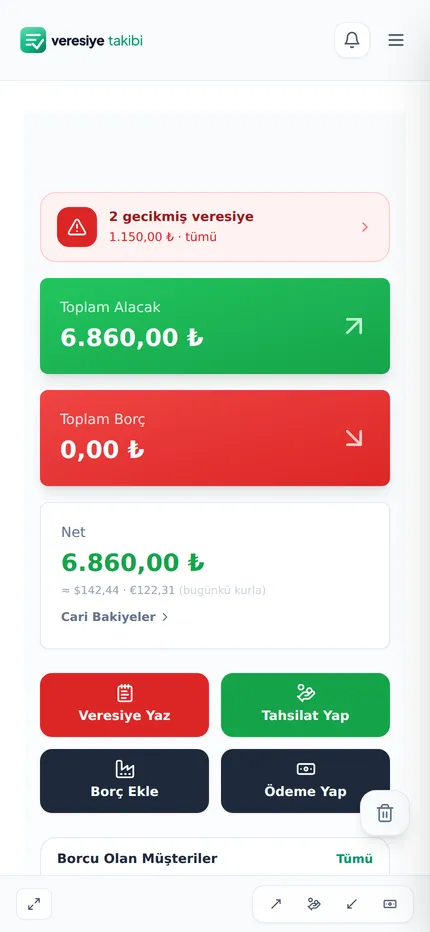
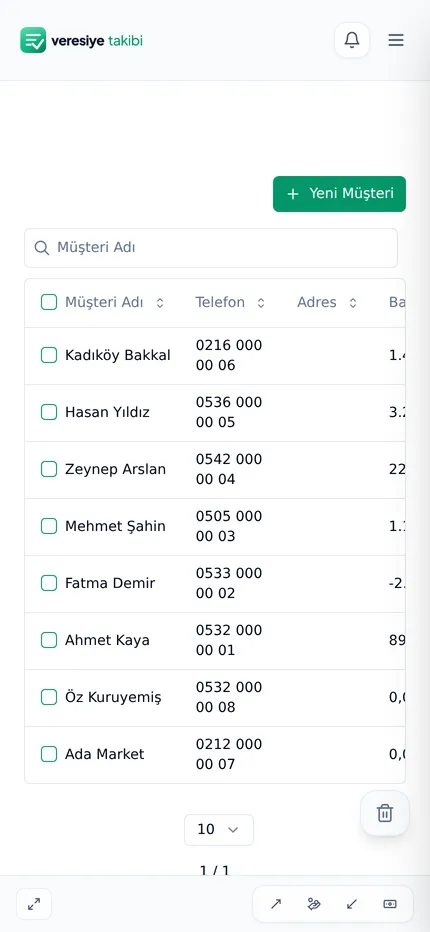
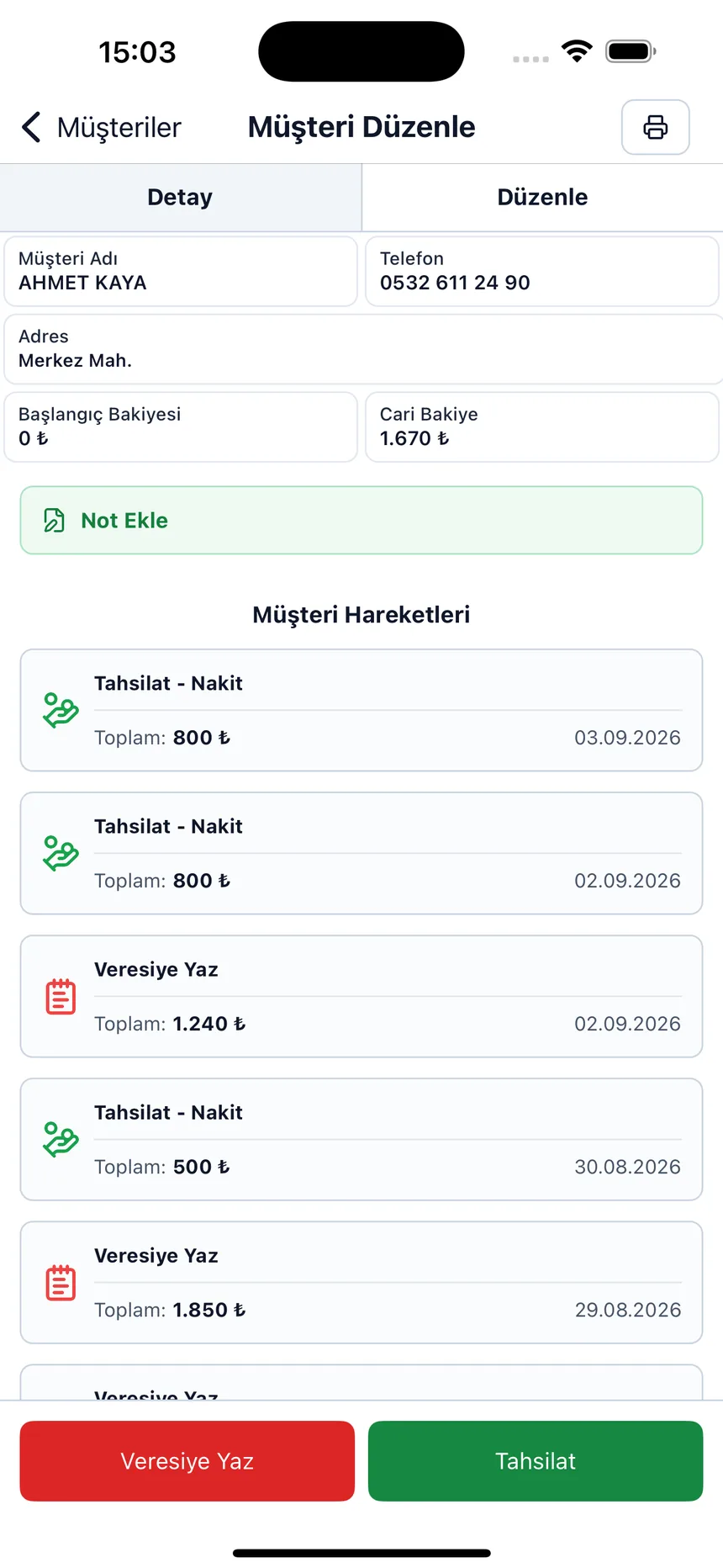
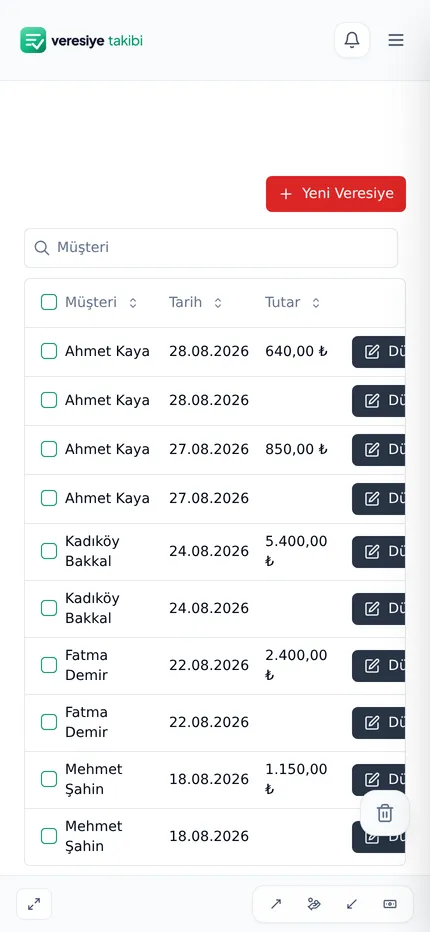
Let the app tell you whom to call today
Due and overdue receivables are in a single list; the reminder message is ready with the customer's name and balance.