
Credit ledger example
A credit ledger example is a six-column table in which a separate page is opened for each customer and every row on that page records a single transaction: date, description, credit amount, payment amount, remaining balance and promised payment date. The remaining balance is recalculated on each row — the new credit is added to the previous balance and the payment made is subtracted; the figure on the last row is that customer's current debt.
Last updated: September 16, 2026
What does a customer page look like?
The example below is a ledger page a grocer keeps for a single customer. At the top of the page the customer's name and phone number are written once; each row below it is a single purchase or a single payment.
Customer: Ahmet Yılmaz · Phone: 05xx xxx xx xx · Limit: 1.500 ₺
| Date | Description | Credit (₺) | Payment (₺) | Balance (₺) | Promised |
|---|---|---|---|---|---|
| 01.09.2026 | Carried forward (from August) | 450,00 | — | 450,00 | — |
| 03.09.2026 | Bread, milk, tea | 310,00 | — | 760,00 | 15.09.2026 |
| 07.09.2026 | Cash payment | — | 500,00 | 260,00 | — |
| 10.09.2026 | Detergent, napkins | 185,50 | — | 445,50 | 25.09.2026 |
| 14.09.2026 | Beef, chicken | 620,00 | — | 1.065,50 | 25.09.2026 |
| 16.09.2026 | Bank transfer | — | 400,00 | 665,50 | — |
Page total: credit 1.565,50 ₺ (including carried forward), payments 900,00 ₺, balance 665,50 ₺. Since the limit is 1.500 ₺, credit can still be given; after the purchase on September 14 the balance had risen to 1.065,50 ₺ and there were 434,50 ₺ left to the limit.
What do you write in each column?
| Column | What to write | What happens if you skip it |
|---|---|---|
| Date | The day the transaction happened — that day, not in a batch in the evening | The order gets mixed up and you can't tell when each debt arose |
| Description | Items bought or payment type (cash, bank transfer, card) | A “what did I buy?” argument comes up |
| Veresiye (credit sales) | The amount of that purchase, to the cent | Rounded-off cents mean the total doesn't match at month-end |
| Payment | The money received; partial payments are also written the same day | The customer thinks they paid, you think they didn't |
| Balance | Previous balance + credit − payment | You have to add up the whole page to see the current debt |
| Promised | The date the customer gave for payment | You can't single out the late receivable as “late” |
The whole ledger: customer summary
The individual pages answer “how much does this customer owe?” To answer “how much money do I have out on the street in total?” put a summary page at the front of the ledger and update it once a week. A sample summary as of September 16, 2026:
| Customer | Balance (₺) | Promised date | Status |
|---|---|---|---|
| Ahmet Yılmaz | 665,50 | 25.09.2026 | Not yet due |
| Zeynep Demir | 1.240,00 | 05.09.2026 | 11 days late |
| Hasan Koç | 380,00 | 20.09.2026 | Not yet due |
| Mehmet Arslan | 0,00 | — | Settled on Sept 12, 2026 |
| Total | 2.285,50 | — | Overdue: 1.240,00 ₺ |
The only job of this summary is to keep two numbers in front of you: the total money out on the street and how much of it is overdue. If the second number is growing, the problem is not in the ledger but in your collection habits.
Closing the credit ledger
“Closing” describes two separate jobs, and they get mixed up.
Closing a customer's account: you collect payments until the remaining balance reaches zero, write the payment on the last row and the balance shows 0,00. Add a dated “settled” note at the bottom of the page. In the summary above, Mehmet Arslan is in this state. Don't tear the page out — the history of a settled account is the only record showing a customer's payment habits when the same customer asks for credit again.
Closing the ledger at the end of a period: at the end of the month or year the total of each page is taken, the remaining balances are written on the summary page and carried to the new ledger as a single carried-forward row — the 450,00 ₺ row dated Sept 1, 2026 on the example page is exactly that. Keep the old ledger; it is your evidence in a dispute over a receivable.
Three common mistakes when filling in the example
Leaving the balance column empty. In a ledger where only credit and payments are written, you have to add up the page from the beginning every time to see the current debt; after a few months nobody does it. Not writing which debt a payment applies to. Unless agreed otherwise, a payment is deducted from the oldest debt, but if the customer is paying for a specific purchase, note that in the description. Skipping the promised date. You can't say a receivable with no date is late; it is the one type of receivable that can't be followed up.
Keeping the same example in Excel or an app
The six columns above carry over to Excel as they are; when you tie the balance column to a formula, every row is calculated automatically. If you want a ready-made file, you can download the free credit ledger Excel template: the remaining balance, amount paid and days overdue are calculated with formulas.
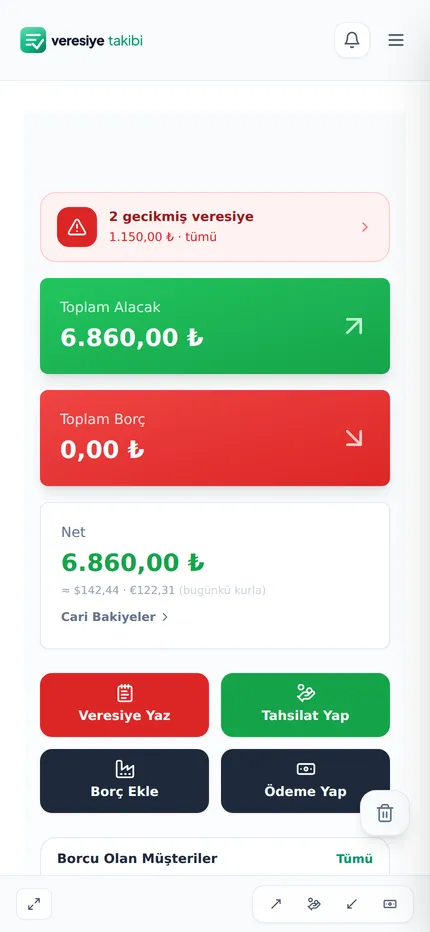
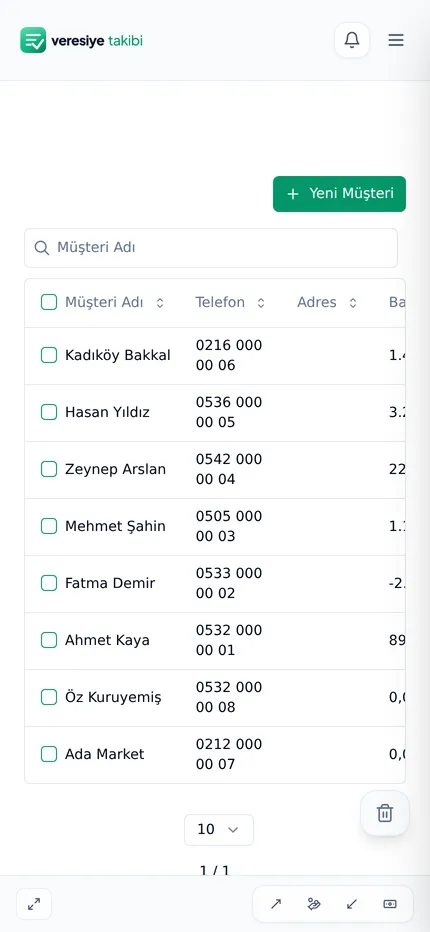
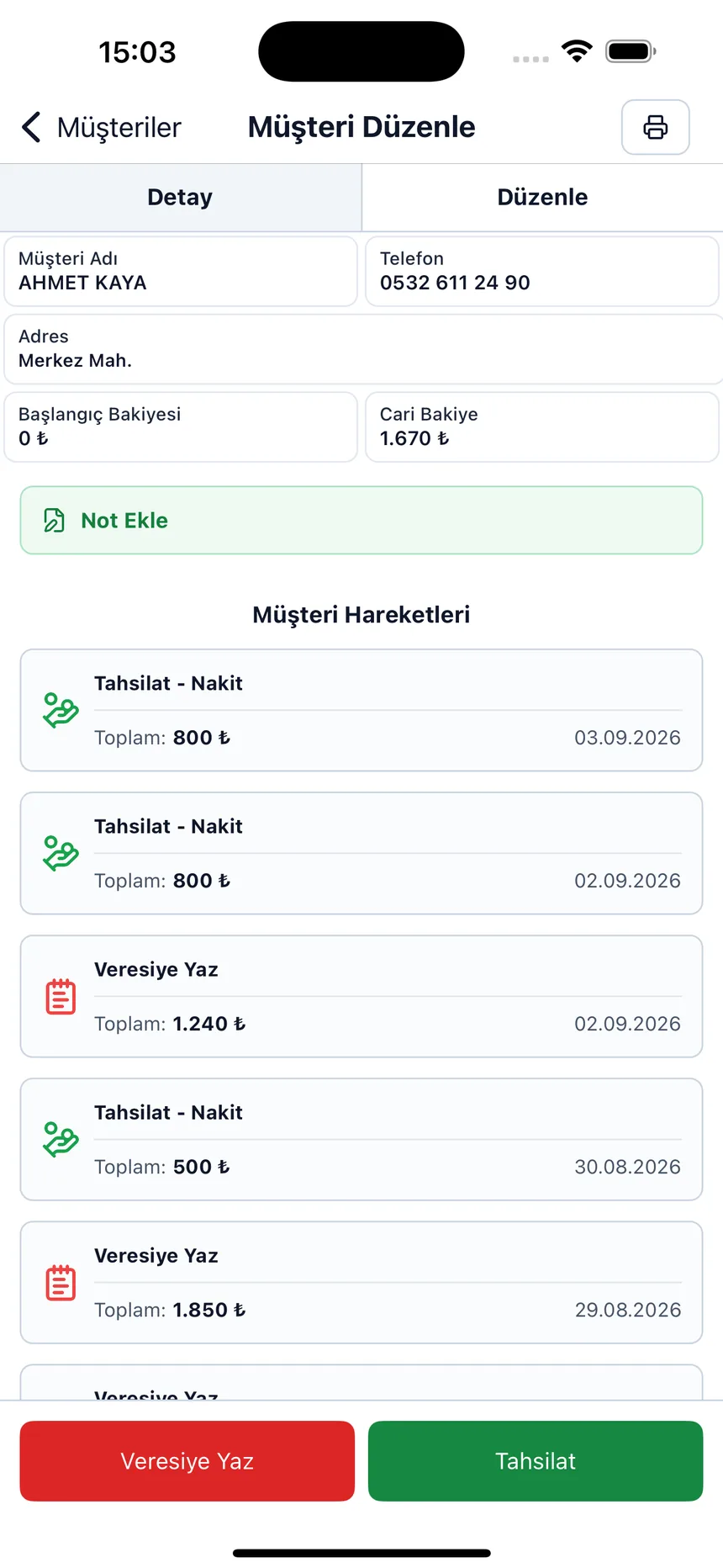
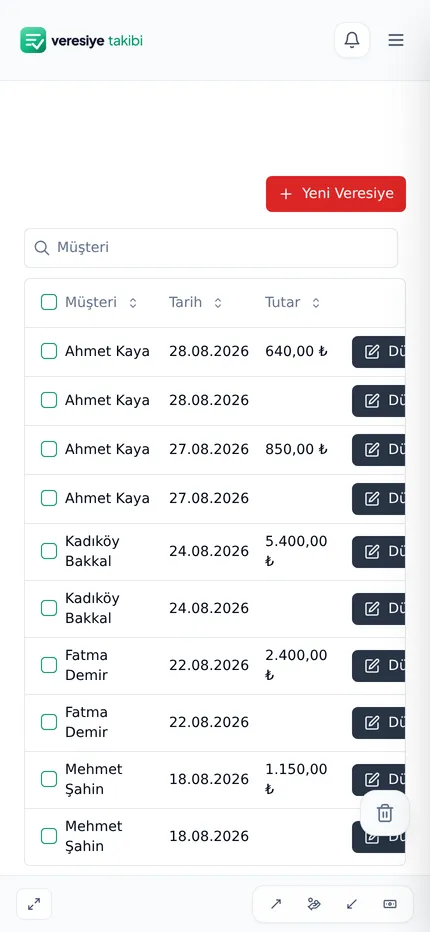
In Veresiye Takibi, the equivalent of this page is the customer card: every transaction is listed with its date, the remaining balance runs automatically, and overdue accounts appear at the top of the home screen. If you want to know which entry goes on which side, see what is a customer account (cari hesap); for what to do when a payment never arrives, see how to collect credit sales (veresiye); and for how to talk about limits and payment terms when selling to businesses, see what is open account. For how to keep the ledger, which habits speed up collection and how to set a limit, see how to keep a credit ledger (veresiye defteri).
Frequently asked questions
How do you fill in a sample credit ledger?
Open a separate page in the ledger for each customer and write one transaction per line on that page: date, description, credit amount, payment amount and remaining balance. The remaining balance is recalculated on every line — the new credit is added to the previous line's balance and any payment made is subtracted.
Which columns should a credit ledger have?
Six columns are enough: date, description (what was bought or the payment type), credit amount, payment amount, remaining balance and the promised payment date. The customer's name and phone number are written once at the top of the page, not repeated on every line.
Which debt does a payment reduce?
The oldest one, unless agreed otherwise. If the customer says "I'm paying for last week's meat," write that in the description; if you don't, which purchase was settled becomes a point of dispute a few months later.
What does closing a credit ledger mean?
It is used in two senses. Closing a customer's account means bringing the remaining balance to zero and adding a dated "closed" note to the page. Closing the ledger means totaling up at the end of a period and carrying the remaining balances over to the new ledger as carry-forwards.
What is a carry-forward and how is it written?
A carry-forward is the debt left over from the previous period, and it is written on the first line of the new page. You don't need to transfer past transactions one by one; a single line with the total remaining amount is enough.
Should I round the amounts when writing in the ledger?
No. Every line where the cents are dropped leads to totals that don't match at month-end and to arguments with the customer over figures. Write the cents too; keep the authority to waive small change for the moment of collection.
What can I use instead of a paper ledger?
You can keep the same column layout in Excel or in a credit tracking app. The difference is this: in Excel a formula calculates the remaining balance but you track lateness yourself; in an app, overdue accounts automatically rise to the top of the list.
What a ledger page looks like in the app
Don't add up the remaining balance yourself
Enter the transaction, and the remaining debt, the overdue accounts and the total money you have outstanding are calculated automatically.